

Top Digital Trends in Hospitality 2026 – The Applied Intelligence Era
All images in this article are AI generated, using prompt engineering and creative direction by Panadvert
Panadvert Talks – Listen to the Podcast Version
Thirteen years back, we started tracking where hospitality marketing was headed. Now, as 2026 approaches, that landscape barely resembles what we first saw. We’ve watched hotels shift from brochure websites to AI booking engines, from spray-and-pray campaigns to systems that predict what guests want before they ask.
Last year felt like one big experiment – everyone testing new tools, some sticking, some not. But 2026? That’s when marketing stops being about which channels you use and becomes about how intelligent your systems are.
These trends we’re sharing? They aren’t optional experiments. They’re rewriting the hospitality playbook from scratch.
1. The Boom of Artificial Intelligence: From Generative to Agentic
“The user is no longer searching for a brand, but for specific attributes. The AI selects and recommends the brand”
Sure, hotels have been playing with AI, chatbots here, email drafts there. But 2026 is different. This is the year AI stops just writing your copy and starts actually making decisions.
-
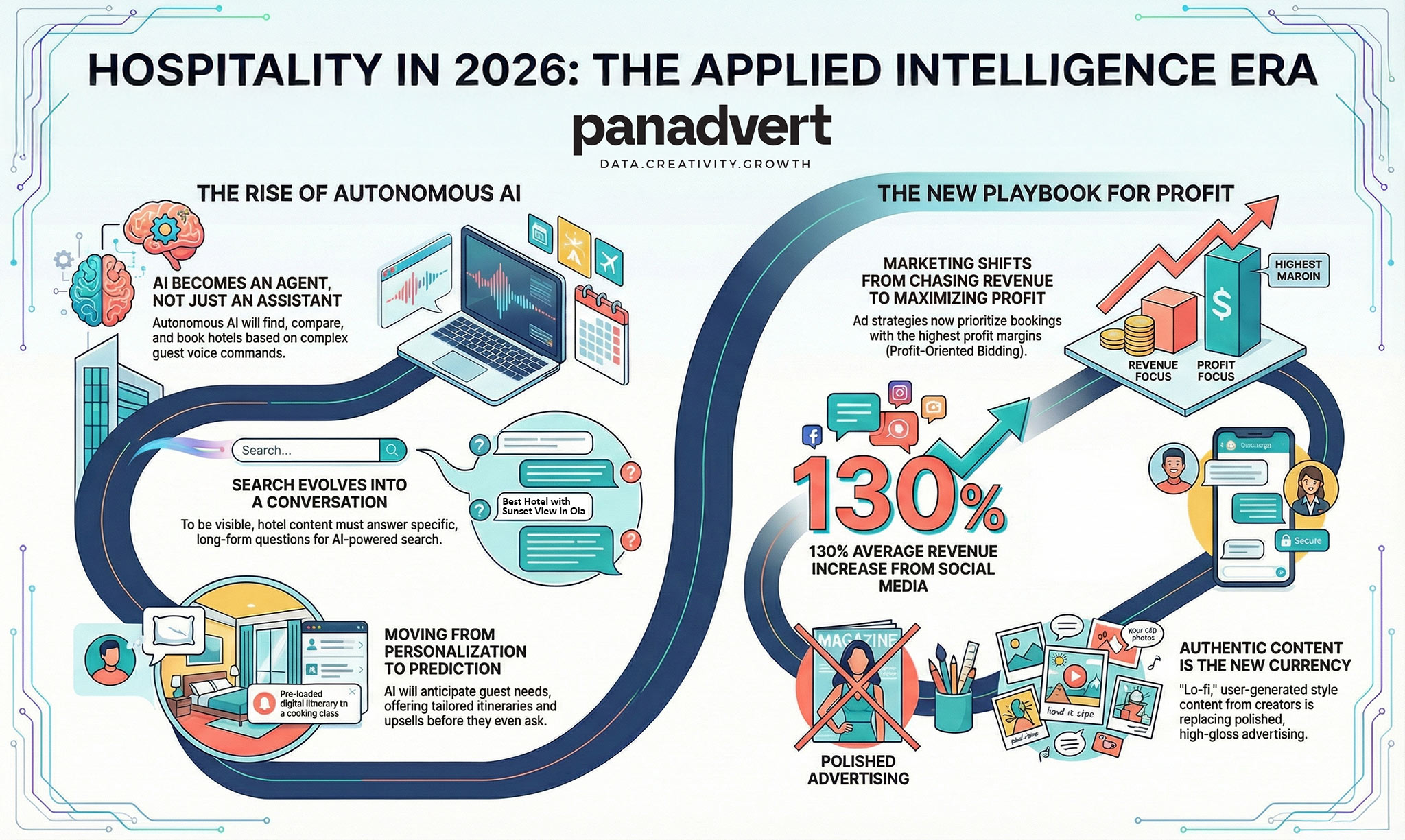
- From Generative to Agentic AI This is the year AI moves from “words” to “actions.” Until now, AI like ChatGPT, helped us draft text or suggest an email. In 2026, we enter the era of Agentic AI, where models act autonomously. Travelers will no longer just search; they will (voice) command: “Find me a room with an indoor pool in Oia for next weekend, under €800, and book it.” AI Agents will contact advanced booking engines, compare real-time pricing, and execute reservations autonomously. Consequently, hotel data (availability, amenities, pricing) must become “machine-readable” via Structured Data (Schema.org) and live API connectivity. If an AI agent cannot read the hotel’s data instantly, simply won’t exist in the results.
-
- Google SGE Optimization: Search becomes Conversation. The new SEO is about answering questions. With Google’s Search Generative Experience (SGE), the search engine behaves like an intelligent consultant. Traditional keyword targeting (e.g., “Hotel in Paros”) is fading. Search is becoming conversational. Users now voice command, “Which is the best hotel in Mykonos for a couple seeking privacy, vegan breakfast options, and a sunset view pool?” To appear in these results, content must target Long-Tail Queries and Perspectives.
- Sponsored Visibility in AI Environments A major prediction for 2026 is the emergence of paid placements and sponsored answers within AI interfaces (ChatGPT, Gemini, Grok, etc.). This represents an entirely new Ad Inventory. Panadvert is already in the preparation phase, establishing structured AI context within major LLM ecosystems to ensure our partners secure sponsored visibility and measurable attribution as this trend explodes.
- AI Revenue Management Systems like Hotellistat are now aggregating market trends, weather patterns, and competitor rates to offer real-time, machine-learning-based pricing. This “Automated Sales Technology” is essential for dynamic competitiveness.
All images in this article are AI generated, using prompt engineering and creative direction by Panadvert
2. Social Commerce & Messaging Commerce
Social commerce has quickly risen to become a dominant revenue driver. Over the past year, we observed an average 130% increase in revenue generated from social media channels among our clientele. However, the definition of Social Commerce is expanding.
-
- The Rise of Messaging Commerce Booking has gone private. Forget clunky forms, guests now DM hotels on WhatsApp, Viber, Instagram, or live chat. The 2026 model? A hybrid service: AI concierge handles the opening back-and-forth and initial offers, then smoothly passes the entire conversation thread to a human agent who already knows the guest’s story.
- The Standard: AI response in <2 minutes; Human handover in <10 minutes.
- The Result: International case studies show a 30% to 50% increase in conversion leads, with significantly lower CPA and higher guest satisfaction.
3. Performance Marketing: Profit-Oriented Bidding
Performance advertising is evolving from revenue-chasing to profit-maximizing. In 2026, we are shifting the primary metric from ROAS (Return on Ad Spend) to Profit-Oriented Bidding (POB). Marketing strategies are now designed to prioritize bookings with higher profit margins rather than just topline revenue.
-
- Channel Diversification While Google remains the leader for direct bookings, we observe a rise in alternative channels with high purchase intent. Microsoft Advertising is making a dynamic comeback, driven by the Bing/ChatGPT integration. The audience here is often more mature, with higher disposable income, looking for specific solutions rather than just browsing.
- Algorithmic Budgeting with Plan Master To navigate this complex, multi-channel landscape efficiently, static Excel spreadsheets are obsolete. Panadvert leverages its proprietary Plan Master technology, an algorithmic media-plan generator that dynamically aligns budget allocation with real-time market demand. By simulating various spending scenarios against projected revenue, Plan Master ensures that marketing investments are not just spent, but strategically deployed to maximize net profit.
All images in this article are AI generated, using prompt engineering and creative direction by Panadvert
4. Enhanced Content Strategy: Lo-Fi Luxury
Content is still king, but the “crown” has changed. High-gloss perfection is out; authenticity is in.
-
- The Rise of “Lo-Fi” Luxury: Audiences are tired by over-stylized and”perfect” videos. The trend for 2026 is “Authentic & Raw” and UGC style content that looks like it was shot on a mobile phone (but with professional art direction) builds immediate trust.
- Short-Form Video as a Performance Funnel: TikTok and Reels are no longer just for awareness. With direct booking integrations, they are full-funnel performance channels. Crucially, videos must have captions and keywords to be discoverable by TikTok Search and Google, and be legible even with sound off.
- “Silent Travel” Aesthetics: A visual trend emerging as an antidote to digital burnout. Content that emphasizes quiet luxury, ASMR sounds of nature, and disconnection.
- Structured Content Systems: At Panadvert, we no longer approach content as a series of isolated posts. We implement scalable production pipelines with repeatable formats and visual rules, ensuring consistent, measurable performance.
5. Market Positioning Systems (MPS)
-
- Market Positioning Systems (MPS) are essential tools for understanding a hotel’s standing in the competitive landscape. Bridging the gap between Rate Shoppers and Revenue Management Systems, tools like HotelInsider offer a visual representation of a hotel’s pricing relative to the entire market (Region, City, or Country). This helps identify if a property is under- or over-priced based on its quality score, independent of immediate comp-set pressures.

All images in this article are AI generated, using prompt engineering and creative direction by Panadvert
6. The Creator Economy & Whitelisting
Influencer marketing has fundamentally changed. In 2026, we stop paying people just to “post.” We pay creators to produce assets.
-
- From Influencing to Whitelisting The strategy is now about Renting the Content, not just the Audience. We commission creators to produce high-quality, native-style content, which we then run as paid ads (Whitelisting / Spark Ads) through their handles. This combines the authenticity of a creator with the targeting precision of a performance campaign, driving direct bookings rather than vanity metrics like “likes.”
Ai Generated Video, using prompt engineering and creative direction by Panadvert
7. Proactive Guest Experience
In 2026, true luxury is about knowing what the guest wants before they ask. We are moving away from basic “Hyper-personalization” to Predictive Personalization. By leveraging AI to analyze past behaviors and lookalike data, hotels can anticipate needs with uncanny accuracy.
-
- Anticipatory Itineraries: Instead of a generic welcome email, AI analyzes the profile (e.g., “Adventure Couple” vs. “Wellness Solo”) to auto-generate a PDF guide with hiking maps or spa slots pre-selected.
- Dynamic Upselling: The system recognizes a guest who historically books late dinners and automatically offers a “Priority Sunset Reservation” upon booking, increasing TRevPAR.
- The “Invisible” Concierge: Apps that send push notifications based on real-time context (e.g., “It’s windy at the beach today; we’ve reserved a sheltered cabana for you by the main pool”).
All images in this article are AI generated, using prompt engineering and creative direction by Panadvert
8. Attribute-Based Selling (ABS)
-
- We are moving away from traditional room categories (Standard, Deluxe, Garden View). In the age of AI search, travelers select based on specific Attributes (e.g., “high floor,” “king bed,” “sunset view,” “standalone tub”). Marketing and booking engines must now sell Attributes, not Labels. This allows for more precise matching of guest needs to inventory, often resulting in higher ADR as guests pay for the specific features they value most.

All images in this article are AI generated, using prompt engineering and creative direction by Panadvert
9. First-Party Data & Measurement 2.0
With the end of third-party cookies (Chrome Privacy Sandbox) now a reality, Data Sovereignty is the only path forward.
-
- Server-Side Tracking: Panadvert has invested heavily in technologies like Panel Analytics, where all data is collected server-side and owned exclusively by the hotel. This ensures accuracy, compliance, and independence from external platforms.
- Measurement 2.0: As attribution becomes more complex, Last-Click ROAS is no longer sufficient. We are moving toward holistic measurement models that assess the contribution of every touchpoint in the user journey.
All the above represent the evolution of our previous insights. To see how far we’ve come, read our 2025 trends report here.
© 2025 Data Analysis Dept. Based on “Athens Rising” Report.

Promoting Your Hotel’s Amenities: A Complete Guide
In a world where travelers crave experiences that go beyond a plush bed and a scenic view, your hote

Visual Storytelling in Seconds: Short Videos for Social Media
In the ever-evolving landscape of social media, where attention spans are short and visual content i

Cavo Marelia – How Panadvert Named Karpathos’ New Star
In the heart of the Aegean, where the sea hugs the land and the light of Karpathos becomes an experi